
Publications
Company Formation in Turkey (2026): How Foreigners Can Register a Company
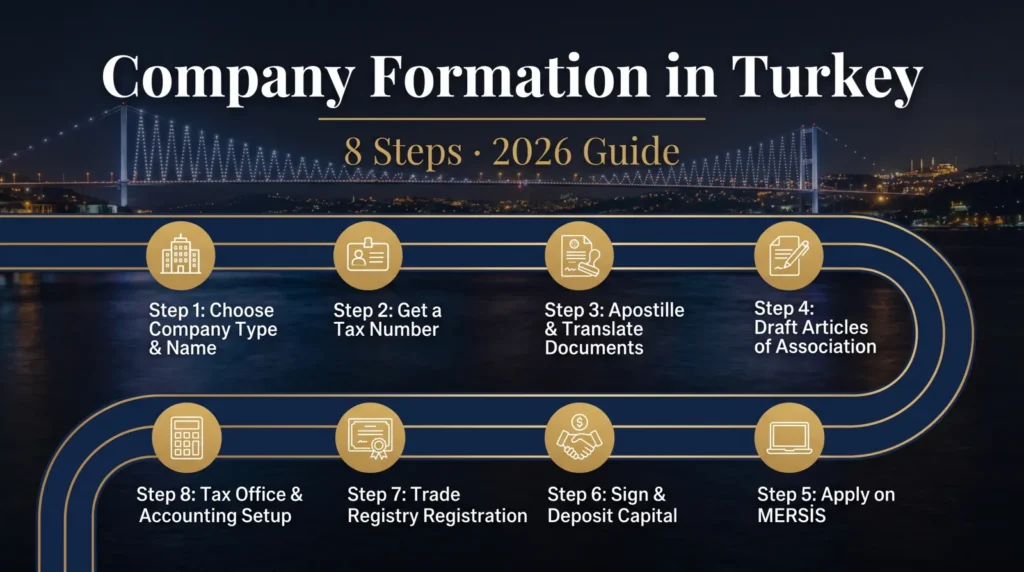
Foreign nationals and foreign companies can set up a company in Türkiye on the same terms as Turkish investors. The most common choices are a limited company (limited şirket, Ltd. Şti.) and a joint stock company (anonim şirket, A.Ş.), and both can be formed with a single shareholder. Since 2024, the minimum capital is TRY 50,000 for a limited company and TRY 250,000 for a joint stock company. The application is made online through the MERSİS system, and the company acquires legal personality when it is registered with the trade registry.
In this article I explain whether foreigners can open a company in Türkiye, how to choose between a limited company, a joint stock company and a branch, the step-by-step registration process, the documents foreign founders need, the cost items, setting up in a free zone, and what comes after registration, such as the bank account, work permit and residence permit, under the Turkish Commercial Code No. 6102 and the Foreign Direct Investment Law No. 4875.
Can a Foreigner Open a Company in Turkey?
Yes. Unless international agreements or special laws provide otherwise, foreign investors are free to make direct investments in Türkiye and are subject to equal treatment with domestic investors (Law No. 4875, Art. 3). There is no requirement to have a Turkish partner, and a foreign individual or a foreign company can own 100% of the shares. Net profit, dividends, sale and liquidation proceeds can be transferred abroad freely through banks.
A few sectors are subject to special licensing or ownership rules, such as banking, insurance, broadcasting, aviation and certain activities in military security zones. For ordinary trade, manufacturing, services, e-commerce and import-export activities, the general rules below apply.
Limited Company, Joint Stock Company or Branch?
| Limited company (Ltd. Şti.) | Joint stock company (A.Ş.) | |
|---|---|---|
| Minimum capital (2026) | TRY 50,000 | TRY 250,000 (TRY 500,000 in the authorised capital system) |
| Shareholders | 1 to 50 | 1 or more, no upper limit |
| Capital payment | Within 24 months after registration | At least 25% of cash capital before registration, the rest within 24 months |
| Management | One or more managers (müdür) | Board of directors (one or more members) |
| Share transfer | Written agreement with notarised signatures and, unless the articles say otherwise, approval of the general assembly | Easier; shares can be transferred without notarisation |
| Liability for unpaid public debts | Shareholders are liable in proportion to their shares | Shareholders are not liable as such; board members may be liable as legal representatives |
Limited company: The most common choice for small and medium businesses because of its lower capital and simpler structure. Shareholders are not liable for the company’s debts (Turkish Commercial Code, TCC Art. 573), but there is an important exception: if taxes and other public receivables cannot be collected from the company, limited company shareholders are directly liable for them in proportion to their shares (Law No. 6183, Art. 35). Transferring shares requires a written agreement with notarised signatures and, unless the articles of association provide otherwise, the approval of the general assembly (TCC Art. 595).
Joint stock company: Preferred for larger projects, investments with several partners, companies that plan to bring in new investors or go public, and for activities where the law requires this form. Share transfers are more flexible, and shareholders are not personally liable for the company’s public debts. In both company types, the managers or board members who represent the company may be held liable for public debts that cannot be collected from the company (Law No. 6183, Art. 35 bis).
Branch office: A foreign company can also register a branch in Türkiye. A branch is not a separate legal entity: the parent company is fully liable for its obligations. It is registered with the trade registry and can carry out commercial activity.
Liaison office: A foreign company may open a liaison office with the permission of the Ministry of Industry and Technology, but only on condition that it carries out no commercial activity in Türkiye. It is suitable for market research or coordination, not for selling goods or services.
The 2026 minimum capital amounts were set by Presidential Decision No. 7887 of 24/11/2023, which raised the amounts in TCC Arts. 332 and 580.
How to Register a Company in Turkey: Step by Step
- Choose the company type, trade name and registered address. The trade name must include the company type and must not be confusingly similar to an existing name. A real address in Türkiye is required for the registered office; many start-ups use a rented office or a virtual office address.
- Obtain a tax number for foreign founders. Foreign individual and corporate shareholders and managers need a Turkish tax identification number, which can be obtained from a tax office with a passport or corporate documents.
- Prepare the documents abroad. Documents issued abroad must be apostilled (or legalised by a Turkish consulate if the country is not a party to the Apostille Convention) and translated into Turkish by a sworn translator with notarisation.
- Draft the articles of association. The articles set out the trade name, registered office, field of activity, capital, share structure and management. Well-drafted articles prevent many later disputes, for example on share transfers, pre-emption rights and deadlock between partners.
- Apply through MERSİS. The incorporation application is made online through the Central Registry System (MERSİS) of the Ministry of Trade.
- Sign the articles and deposit the capital. The founders sign the articles before an authorised officer of the trade registry. For a joint stock company, notarised signatures are also accepted (TCC Arts. 335, 575). A founder who cannot come to Türkiye can be represented by a proxy holding a power of attorney issued at a Turkish consulate or apostilled abroad. For a joint stock company, at least 25% of the cash capital is deposited in a bank account opened in the name of the company before registration (TCC Arts. 344, 345). For a limited company, this pre-registration payment is not required since 2018 (TCC Art. 585). In both cases, 0.04% of the capital is paid to the Competition Authority (Law No. 4054, Art. 39).
- Registration and announcement. The trade registry directorate of the chamber of commerce where the registered office is located registers the company, and the registration is published in the Turkish Trade Registry Gazette. The company acquires legal personality on registration.
- Tax office and books. After registration, the tax office opens the company’s tax record and usually inspects the address. The company’s legal books (or e-books) are set up and an accountant is appointed.
When all documents are complete and correct, registration itself is usually completed within a few working days. Most delays come from documents issued abroad: missing apostilles, untranslated pages or inconsistent names and addresses.
Documents Required for Foreign Founders
Foreign individuals:
- Passport, with a notarised Turkish translation,
- Turkish tax identification number,
- Address information and, if they will act through a representative, a power of attorney.
Foreign companies as shareholders:
- A certificate of incorporation or trade registry extract showing that the company exists and who represents it, apostilled and translated,
- A board resolution approving the investment in Türkiye and authorising a representative,
- A power of attorney for the person who will sign in Türkiye,
- A Turkish tax identification number for the foreign company.
The trade registry may ask for additional documents depending on the field of activity and the structure of the company, so the list should be checked before documents are prepared abroad.
Company Formation Cost in Turkey
The total cost depends on the company type, capital and how the documents are prepared. The main cost items are:
- Trade registry fees and the Trade Registry Gazette announcement fee,
- The Competition Authority share (0.04% of the capital),
- Notary fees for signatures, translations and powers of attorney,
- Apostille and sworn translation costs for documents issued abroad,
- Office or virtual office rent,
- Accountant and legal fees.
The capital itself is not a cost: it remains the company’s asset and can be used for the company’s activities.
Setting Up a Company in a Free Zone
Free zones are areas within Türkiye that are treated as outside the Turkish customs territory for customs duties, trade policy measures and foreign exchange rules (Free Zones Law No. 3218, Art. 6). Turkey’s first free zone was established in 1987 in Mersin, next to Mersin Port, and free zones now operate in many regions of the country.
To operate in a free zone, a company needs an operating licence from the Ministry of Trade in addition to its trade registry registration, and leases or buys space in the zone. A company may be set up specifically for the free zone, or an existing Turkish company may obtain a licence.
Tax advantages are narrower than often described. Under Provisional Article 3 of Law No. 3218, as amended in 2024 and 2026:
- The income of manufacturers from selling goods they produce in the zone is exempt from income or corporate tax only for sales abroad, within the free zone or to other free zones. Sales into Türkiye are not covered.
- Certain services, such as maintenance, repair, assembly, handling, packaging, labelling, testing and storage, are exempt only if provided entirely to non-residents and the goods are sent abroad without entering Türkiye.
- Income tax on employee wages is cancelled for manufacturers that export at least 85% of the FOB value of the goods they produce in the zone.
- Transactions and documents related to activities in the zone are exempt from stamp duty and fees.
Trading (buying and selling) companies in a free zone therefore do not benefit from a corporate tax exemption under the current rules. Before choosing a free zone, the planned activity, customers and the share of exports should be assessed together.
After Registration: Bank Account, Work Permit and Residence Permit
Bank account: The company opens a corporate account with its registration documents and tax number. Banks apply their own know-your-customer checks to foreign shareholders and managers, and they usually require the representatives to appear in person or to be represented under a power of attorney.
Work permit: Being a shareholder does not by itself require a work permit. A foreigner who will actually work for the company, for example as a manager of a limited company or a board member of a joint stock company, needs a work permit, and partner-managers can obtain one under Law No. 6735, Art. 10/5. The criteria, fees and process are explained in detail in my article on the work permit in Turkey.
Residence permit: Foreigners who will set up a business or establish commercial connections in Türkiye can apply for a short-term residence permit (Law on Foreigners and International Protection No. 6458, Art. 31/1-c). A work permit also serves as a residence permit. See the residence permits page for the procedure.
Ongoing obligations: The company must keep its legal books, file tax returns, hold annual general assembly meetings, register changes such as a new manager, address or capital with the trade registry, and register employees with the Social Security Institution before they start work.
Legal Support for Company Formation
Company formation itself is largely a registry procedure, but the decisions made at this stage, such as the company type, the articles of association, the share structure and the agreement between the partners, determine how disputes, exits and transfers will be handled later. Carefully drafted articles and a shareholders’ agreement are the main safeguard against future shareholder disputes. I provide legal support for company formation, articles of association and commercial contracts in files from anywhere in Türkiye. You can reach me through the contact page for an assessment of your plans.
Frequently Asked Questions
Can a foreigner own 100% of a company in Turkey?
Yes. Foreign investors are subject to equal treatment with domestic investors and can own all the shares of a limited or joint stock company. A Turkish partner or local director is not required.
What is the minimum capital for a company in Turkey in 2026?
TRY 50,000 for a limited company and TRY 250,000 for a joint stock company (TRY 500,000 for a non-public joint stock company in the authorised capital system), under Presidential Decision No. 7887.
Can I register a company in Turkey without coming to Turkey?
Yes. The articles can be signed by a representative holding a power of attorney issued at a Turkish consulate or notarised and apostilled abroad. However, banks may still require in-person verification to open the company’s account.
How long does company registration take in Turkey?
Once the documents are complete, registration at the trade registry is usually completed within a few working days. Preparing, apostilling and translating documents abroad generally takes longer than the registration itself.
Can a company be registered online in Turkey?
The incorporation application is made online through MERSİS, but the articles must be signed before the trade registry (or, for a joint stock company, a notary), so the process is not entirely online.
Do I need a work permit if I am a shareholder?
Not if you are only a shareholder and do not work in Türkiye. If you will work for the company, for example as a manager or a board member, you need a work permit.
Are free zone companies tax-free in Turkey?
Not in general. Under the current rules, the corporate tax exemption covers manufacturers’ income from goods produced in the zone and sold abroad, within the zone or to other free zones, and certain services provided to non-residents. Trading companies do not benefit from a corporate tax exemption.
Related posts

Work Permit in Turkey 2026: Requirements, Fees and How to Apply
Work permit in Turkey 2026: permit types, the Ministry's current assessment criteria, application and extension, exemptions, fees, objections to rejection and fines for working…
Read the article